

How To Create A Guide Template On Indesign
Equitable Language: We are replacing not-inclusive language from InDesign 2022 (version 17.0) onwards, to reflect core Adobe values of inclusivity. Any reference to Master page is replaced by Parent page in our Help articles for the English language, Danish, Hungarian, Spanish, Italian, Brazilian, Portuguese, and Japanese locales.
Create ruler guides
Ruler guides are different from grids in that they can exist positioned freely on a page or on a pasteboard. You tin create two kinds of ruler guides: page guides, which appear only on the page on which you create them, or spread guides, which bridge all pages and the pasteboard of a multiple-page spread. You tin can drag any ruler guide to the pasteboard. A ruler guide is displayed or hidden with the layer on which it was created.
New ruler guides always appear on the target spread. For example, if several spreads are visible in the document window and you drag a new guide into the window, the new guide becomes visible only on the target spread.
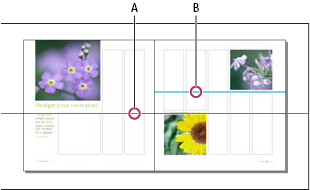
A. Spread guideB. Page guide
Create a ruler guide
-
Make certain that both rulers and guides are visible, brand sure the correct spread is targeted, and view the document in Normal View style, not Preview style.
-
If the document contains multiple layers, click a layer proper noun in the Layers console to target the layer.
-
-
To create a page guide, position the pointer inside a horizontal or vertical ruler and so elevate to the desired location on the target spread. If you drib the guide onto the pasteboard, it spans the pasteboard and spread; it volition act as a page guide if you subsequently elevate it onto a page.
-
To create a spread guide, drag from the horizontal or vertical ruler, keeping the pointer in the pasteboard just positioning the guide at the desired location on the target spread.
-
To toggle betwixt horizontal and vertical guides, select the guide and hold down Alt (Windows) or Option (Mac OS).
-
To create a spread guide when the pasteboard is not visible (for example, when you lot've zoomed in), press Ctrl (Windows) or Control (Mac OS) every bit you elevate from the horizontal or vertical ruler to the target spread.
-
To create a spread guide without dragging, double-click a specific position on the horizontal or vertical ruler. If you want to snap the guide to the nearest tick marking, hold down the Shift key when y'all double-click the ruler.
-
To create vertical and horizontal guides simultaneously, press Ctrl (Windows) or Command (Mac OS) as you drag from the target spread's ruler intersection to the desired location.
-
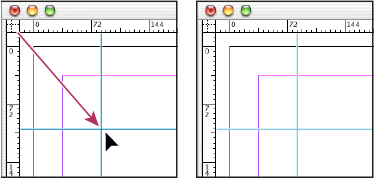
To reposition a ruler guide numerically, select the guide and enter values for X and Y in the Command panel.
Create a ready of evenly spaced page guides
-
If the document contains multiple layers, click a layer name in the Layers panel to target the layer.
-
Cull Layout > Create Guides.
-
For Number, type a value to specify the number of rows or columns you desire to create.
-
For Gutter, type a value to specify the spacing between rows or columns. Outset with a low value, such every bit 1 pica; large gutters leave little space for columns.
Columns created with the Create Guides command are not the same as those created with the Layout > Margins And Columns command. For case, columns created using Create Guides cannot command text catamenia when a text file is placed. Apply the Margins And Columns command to create major column divisions appropriate for autoflow text, and apply the Create Guides command to create column grids and other layout aids.
-
For Fit Guides To, click Margins to create the guides within the page margins, or click Folio to create the guides within the page edges.
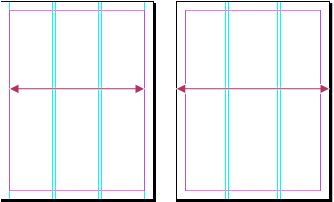
Ruler guides evenly spaced within page margins (left) and page edges (right) -
To delete whatever existing guides (including guides on locked or subconscious layers), select Remove Existing Ruler Guides.
-
If you lot like, select Preview to run into the result of your settings on the page, then click OK.
The Create Guides command can create page guides only; it cannot create spread guides.
To infinite existing guides a compatible altitude apart, select the guides (by dragging or pressing Shift as you click with the mouse). Then, select Apply Spacing from the Control console, type the space value in the text box, and printing Enter or Render to confirm. Click either Distribute Horizontal Centers or Distribute Vertical Centers
 to the left of the Apply Spacing option.
- To bear witness or hide all margin, column, and ruler guides, cull View > Grids & Guides > Show/Hide Guides.
- To show or hide ruler guides on 1 layer just without changing the visibility of the layer's objects, double-click the layer proper name in the Layers panel, select or deselect Bear witness Guides, and then click OK.
- To show or hibernate guides and all other non-printing elements, click the Preview Way icon
 at the bottom of the Toolbox.
Work with ruler guides
You can modify the attributes of individual ruler guides, and y'all can motion, cut, copy, paste, or delete multiple ruler guides simultaneously. Cut or copied ruler guides can be pasted to other pages or documents, only not to other programs. To change attributes of specific guides, you lot must select the guides y'all desire to change. When no guides are selected, the Ruler Guides command sets the defaults for new guides merely.
Select ruler guides
Unselected ruler guides appear light blue by default. Selected ruler guides are highlighted in their layer color. When a guide is selected, the Reference Indicate icon in the Control panel changes to or
or , representing the selected guide.
If yous can't select a ruler guide and the View > Grids & Guides > Lock Guides command is already deselected, the guide might be on that page's parent, or on a layer where guides are locked.
- To select multiple ruler guides, hold down Shift as you click guides using the Selection or Direct Choice tool. You can too drag over multiple guides, equally long as the option marquee doesn't bear upon or enclose whatsoever other object.
- To select all ruler guides on the target spread, press Ctrl+Alt+One thousand (Windows) or Command+Option+Grand (Mac Os).
Movement ruler guides
-
Using Choice tool
 or the Directly Selection tool
  , do any of the post-obit:
 -
To move a ruler guide, drag information technology.
-
To movement multiple ruler guides, shift-select the guides you lot want to movement, and and then elevate them.
Move selected guides just as you would whatever other selected object, including nudging with the arrow keys and using the Control or Transform panels.
-
To brand a guide snap to a ruler tick mark, press Shift every bit you drag it. Or select the guide, press and hold downward the Shift fundamental, and then click the mouse button.
-
To movement a spread guide, drag the part of the guide that's on the pasteboard, or press Ctrl (Windows) or Command (Mac Os) every bit y'all drag the guide from within the folio.
-
To move guides to some other page or certificate, select 1 or more than guides, choose Edit > Copy or Edit > Cut, go to another page, then choose Edit > Paste. If you lot're pasting onto a folio of the same size and orientation as the guides' original page, the guides appear in the same position.
-
The Paste Remembers Layers option affects the layer on which pasted guides appear.
Delete ruler guides
- To delete private guides, select ane or more ruler guides then printing Delete. (You tin can also drag ruler guides and drib them on a ruler to delete them.)
- To delete all ruler guides on the target spread, right-click (Windows) or Ctrl-click (Mac OS) a selected guide or ruler, and choose Delete All Guides On Spread.
If you cannot delete a guide, it may exist locked, information technology may be on a parent page, or information technology may be on a locked layer.
Customize ruler guides
-
-
To change options for i or more existing ruler guides, select those ruler guides.
-
To ready default options for new ruler guides, deselect all guides past clicking in an empty area.
-
-
Choose Layout > Ruler Guides.
-
For View Threshold, specify the magnification beneath which ruler guides exercise not appear. This prevents ruler guides from actualization too close together at lower magnifications.
-
For Color, choose a color or cull Custom to specify a custom color in the system colour picker. And then click OK.
You can prepare the current magnification every bit the view threshold for new ruler guides past pressing Alt (Windows) or Option (Mac OS) as y'all drag the ruler guides you've selected.
Lock or unlock ruler guides
- To lock or unlock all ruler guides, choose View > Grids & Guides > Lock Guides to select or deselect the menu control.
- To lock or unlock ruler guides on ane layer just, without irresolute the visibility of the layer's objects, double-click the layer name in the Layers panel, select or deselect Lock Guides, and so click OK.
Change ruler guide stacking gild
By default, ruler guides appear in front of all other guides and objects. However, some ruler guides may cake your view of such objects as lines with narrow stroke widths. You can change the Guides in Dorsum preference to display ruler guides in front of or behind all other objects. Still, regardless of the Guides in Back setting, objects and ruler guides are always in front of margin and column guides. Also, although putting guides on different layers organizes them structurally, it does not bear upon their visual stacking gild—the Guides in Back preference stacks all ruler guides as a single fix in relation to all folio objects.
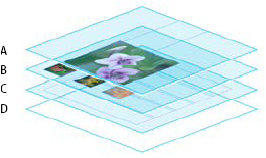
A. Ruler guidesB. Page objectsC. Margin and column guidesD. Page
-
Choose Edit > Preferences > Guides & Pasteboard (Windows) or InDesign > Preferences > Guides & Pasteboard (Mac OS).
-
Select Guides in Back, and click OK.
Snap objects to guides and grids
To precisely align objects to guides, use the Snap To Guides and Snap To Document Filigree commands. Object edges will snap to (be pulled toward) the nearest grid intersection or guide when y'all describe, movement, or resize the objects.
The exact range within which an object snaps to guides is called the snap-to zone, which you lot tin can adapt. When you lot select both the Snap To Guides and the Snap To Document Grid commands, the grid takes precedence.
Proceed the following guidelines in mind every bit you align objects to guides and grids:
-
To snap an object to a guide, drag an object toward a guide until one or more than of the object'southward edges is inside the guide's snap-to zone.
-
Guides must be visible for objects to snap to them. However, objects tin snap to the document and baseline grids whether the grids are visible or not.
-
Objects on one layer snap to ruler guides visible on any other layer. If you don't want objects to snap to guides on a sure layer, hibernate that layer's guides.
-
To snap the text baseline to the baseline grid, cull Grid Alignment > Roman Baseline from the Control panel card or Paragraph panel menu. Alternatively, set Grid Alignment to Roman Baseline from the cavalcade style Filigree Settings.
-
For the baselines of text to snap to the baseline filigree, press the Align to Baseline Grid button
 for individual paragraphs or paragraph styles.
-
Choose View > Grids & Guides and make sure that Snaps To Guides is selected (checked).
The Snap To Guides command controls both snapping to guides and snapping to the baseline grid.
-
To specify the snap-to zone, cull Edit > Preferences > Guides & Pasteboard (Windows) or InDesign > Preferences > Guides & Pasteboard (Mac Bone), type a value for Snap To Zone, and click OK. The Snap To Zone value is ever in pixels.
Utilize smart guides
The Smart Guides feature makes it easy to snap objects to items in your layout. As yous drag or create an object, temporary guides appear, indicating that the object is aligned with an edge or eye of the page or with another page item.
By default, the Smart Guides feature is selected. You can turn off smart guides, or you can plough off whatsoever of the smart guide categories:
Smart Object Alignment
Smart object alignment allows for easy snapping to folio item centers or edges. In improver to snapping, smart guides dynamically draw to indicate which object is being snapped to.
Smart Dimensions
Smart dimension feedback appears when you're resizing, creating, or rotating page items. For example, if yous rotate one object on your page 24 degrees, a rotation icon appears as you rotate some other object close to 24 degrees. This hint lets y'all snap the object to the same rotation angle of the side by side object. Similarly, equally you resize an object next to another object, a line segment with arrows at each end lets y'all snap the object to the aforementioned width or height as the side by side object.
Smart Spacing
Smart spacing lets you quickly arrange page items with the help of temporary guides that indicate when the spacing between objects is even.
Smart Cursors
Smart cursor feedback appears in a grey box as X and Y values when you're moving or resizing object or as a measurement when you're rotating values. The Show Transformation Values option in Interface preferences lets you turn smart cursors on and off.
For a video tutorial on using smart guides, run into world wide web.adobe.com/go/lrvid4029_id.
Turn smart guides on or off
-
Cull View > Grids & Guides > Smart Guides.
Turn smart guide categories on or off
-
Open the Guides & Pasteboard preferences.
-
Indicate whether y'all want Align To Object Center, Align To Object Edge, Smart Dimensions, and Smart Spacing turned on or off, and click OK.
To turn off smart cursors, which displays the 10 and Y values of objects you mouse over, deselect Show Transformation Values in Interface preferences.
Change the appearance of smart guides
-
Open the Guides & Pasteboard section of the Preferences dialog box.
-
Choose a different colour from the Smart Guides menu, and click OK.
Tips for using Smart Guides
-
Smart Guides take issue only on page items and intersections that are in the current page view. If you have many objects on a page and are trying to align an object to some other object or objects in detail, zoom in on that area specifically.If you lot don't desire Smart Guides to snap to column guides, turn off Snap To Guides temporarily by choosing View > Grids & Guides > Snap To Guides.The Smart Guides feature is accurate regardless of zoom percentage, so it isn't necessary to zoom in to see if two objects are really aligned at their left edges, for example.


How To Create A Guide Template On Indesign,
Source: https://helpx.adobe.com/indesign/using/ruler-guides.html
Posted by: pappalardoyouten.blogspot.com
0 Response to "How To Create A Guide Template On Indesign"
Post a Comment