

What Do You Do In Domino's If A Player Has A Play But Still Draws

Domino Game RulesAssistance
Variations
The following 3 versions of domino games are supported:
- Five-up (also known every bit Muggins or All Fives)
- Draw
- Block
5-upward Variation
Object
To exist the beginning person to attain the agreed-upon number of points (100 - 500). Points may exist awarded during the play of the hand by making the exposed ends of the chain total to a multiple of five (5). The winner at the end of each manus also scores points for all the pips remaining in the other player's hand rounded to the nearest multiple of five.
Examples
A thespian scores points if the sum of the two open ends totals a multiple of 5.
| If the dominoes on table are: |  |
| The role player who put the final bone scored 5 points - the some of ends of the above concatenation: 1+4=5 (multiple of 5) | |
| If the next player places: |  |
| the new concatenation will become: |  |
| The player who put the last bone scored 10 points - the sum of ends of the above chain: half-dozen+4=10 (multiple of v) | |
| | |
| If the double is at the open up stop, both sides of the double are counted. In the chain below, the last player scored xv points: 5+v+5=15 | |
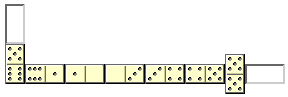 | |
Deal
At the beginning of a game, the hands are dealt by randomly shuffling all tiles and distributing seven (seven) tiles (as well called bones or dominoes) to each thespian. The remaining dominoes are placed in the boneyard to be drawn from by a histrion when he/she cannot play a tile from own mitt.
If this is the starting time hand of a game, the player with double six must play it first (likewise see options below - random 1st hand). If no one has the double 6, the call goes out for double five, then double 4, and and so on until 1 of the players tin produce the called for tile. Players then take turns.
In subsequent hands, the winner of the previous mitt starts the next game (meet Options below: rotated first). When leading in a mitt other than the beginning one in the game, the selection of play may be whatever tile in the pb player's hand.
Game Play
One time the lead tile has been played, the tiles that may exist played are constrained to match the exposed ends of the concatenation.
Players take turns. If a player does not have whatsoever tiles which take a number of pips that matches 1 of the exposed ends of the concatenation, that player must draw from the boneyard one tile at a time until he/she draws one which may be played. If there is no boneyard or are no more tiles left in the boneyard, that player must pass. If a player has at least one tile that matches i of the exposed ends of the chain, that player must play a tile and cannot pass. Play may go along off both ends of the chain, or from the exposed ends of the starting time double that is played once that double has had dominoes played from both its sides. That double is referred to as the spinner because the chain sprouts from all four sides of the domino. At most at that place will be 4 ends of the concatenation exposed; no other double may have additional dominoes played from information technology.
In the picture below, double six was the commencement double placed in the chain and it became a spinner.
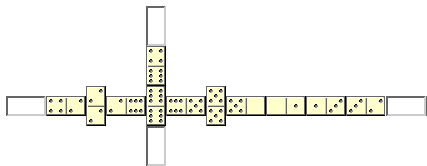
Delight notation: in the above film, the bottom portion of the spinner is not 'activated' for scoring yet -- since no bone was placed there all the same. Thus, in the above domino chain, the some of the stop tiles is: 10 (iv + 4 + 2).
Stop of Play
The first histrion to employ all the tiles wins the game. In one case the winning piece is placed on the chain, the game is over and the players expose their remaining pieces to exist counted in the scoring. No further plays tin can be made by whatsoever of the players. It is possible for the game to reach a dead stop, where all play is blocked and no tiles may be played. This effect is chosen a blocked or jammed game. In this instance, the stop of the game is determined when the boneyard is empty and all players laissez passer consecutively (i.due east., none of the players may brand a legal play). To determine the winner, all tiles held past players must be exposed and counted. The player with the to the lowest degree number of pips on the dominoes nonetheless held is declared the winner.
If a player does not have any tiles which have a number of pips that matches one of the exposed ends of the chain, that thespian must draw from the boneyard one tile at a fourth dimension until he/she draws one which may be played. If at that place are no more tiles left in the boneyard, that actor must pass. If a player has at least one tile that matches one of the exposed ends of the chain, that player must play a tile and cannot pass. When placing tiles on the chain, doubles are placed crosswise then that the stop of the concatenation touches the side of the double. If a tile is played that is not a double, the matching end of the tile is placed adjacent to the terminate of the concatenation to which it matches, with the domino placed in a lengthwise manner.
Play may keep off both ends of the chain, or from the exposed ends of the first double that is played once that double has had dominoes played from both its sides. That double is referred to equally the spinner because the chain sprouts from all four sides of the domino.
Scoring
When summing the ends of the chain, a blank counts as zero points. Any double which is exposed sideways on the end of the chain is scored counting both ends of the domino. For example, if one stop of the chain has a double iv and the other finish has a two, the score is eight (viii) for the double four and two (2) for the two giving a total of 10 (10) points. One time the paw is over, the dominoes held by the other players are totalled and rounded off to the nearest multiple of five (5). This total is added to the winning histrion or team's match score. If the hand was blocked or jammed, the full does non include the number of points held by the jamming player. If the number of points held past each actor is the same, the hand is declared a tie and no extra points are added to any player's score. If all scores are less than agreed-upon number of points for the game (100-500), the game continues by playing another paw.
Options and Defaults
Who starts the 1st manus and how?
- By default, the highest double in the first hand is forced - whoever was dealt the highest double must beginning the 1st hand with it (in the rare example that nobody had any doubles, the highest bone starts).
A domino table can also exist created with an option of Random start (when 'no 1st hand forced double' default option is unchecked). In this case, the server determines randomly which player volition start. If this option is in force, then the role player is costless to chose what bone to start with.
- By default, the winner of the manus starts the new mitt. A domino table can also be created with a non-default choice 'rotated showtime'. With 'rotated start' non-default pick, the starter of the next hand (likewise called 'first downwardly') alternates every paw.
- With the default options (winner starts and 1st hand forced double), if the game is blocked (in Five-Up & Draw games), so the player with the highesr double will offset the side by side hand.
- 100pt/v+ denotes the tabular array set for 100 pt for Five-up (v) with a spinner (+)
- 125pt/five* denotes the table set for 125 pt for Five-up (v) without a spinner (no +) with no forced double (*)
- 125pt/five+O denotes the tabular array set for 125 pt for Five-upwardly (5) with a spinner (+) with rotated start (O)
- 200pt/Drw denotes the table set for 200 pt for Draw variation (Drw) without a spinner (no +)
- 100pt/Blk denotes the table set for 100 pt for Block variation (Blk) without a spinner (no +)
Draw Variation
Equally opposed to V-Upwardly variation in a higher place, points are not awarded during play for making multiples of v. Points are awarded just at the end of each paw.
Each player tries to match the pips on one end of a tile from ain hand with the pips on an open up end of any tile in the chain. If a player is unable to lucifer a tile from own hand with a tile in the chain, the thespian loses the plow. Each player may play merely one tile per turn. If a player cannot friction match a tile with one in the concatenation, that player must draw from the boneyard until the tile that can be played is drawn. If in that location are no tiles left in the boneyard, the player losesthe turn.
The outset player to become rid of all dominoes wins the paw. If none of the players can make a play, the game ends in a block. If a hand ends in a block, the players plough the tiles in their easily faceup for counting. The player with the lowest total wins the paw and earns the points (1 bespeak per pip) of all the tiles left remaining in opponent's hand. The role player who first reaches the agreed-upon number of points (100-500) or more is the overall winner.
Cake Variation
This variation is similar to Describe variation in a higher place, except no role player can depict from a boneyard. If none of the players tin can make a play, the mitt ends in a block. The players turn the tiles in their hands faceup for counting. The thespian with the lowest total wins the hand and earns the points (one betoken per pip) of all the tiles left remaining in opponent'southward hand. The player who first reaches the agreed-upon number of points (100-500) or more is the overall winner.

What Do You Do In Domino's If A Player Has A Play But Still Draws,
Source: https://www.gamecolony.com/andr/dom/dom/dom_rules.html
Posted by: pappalardoyouten.blogspot.com
0 Response to "What Do You Do In Domino's If A Player Has A Play But Still Draws"
Post a Comment